

For decades, the Australian Department of Defence has adhered to an immovable public posture whenever pressed on anomalous or unidentified activity in our skies: “Move along folks, nothing to see here”. Official inquiries, parliamentary questions on notice, and media queries regarding Unidentified Anomalous Phenomena (UAP) are routinely met with the standard bureaucratic brush-off: Defence does not track, record, or investigate UAP, nor does it hold any institutional interest in the subject.
Yet, a newly secured Freedom of Information release (Defence FOI 0261/26/27), coupled with national media reports and ministerial admissions, exposes a staggering double standard.
Between 11-13 July 2026, multiple unauthorised Unmanned Aircraft Systems (UAS) - commonly termed drones - brazenly violated restricted military airspace above RAAF Base Williamtown in New South Wales. Williamtown is not an ordinary airfield; it is Australia’s premier tactical fighter base, home to Headquarters Air Combat Group and the nation’s multi-billion-dollar fleet of 5th-generation F-35A Lightning II stealth fighters and E-7A Wedgetails.
Source: Sunrise
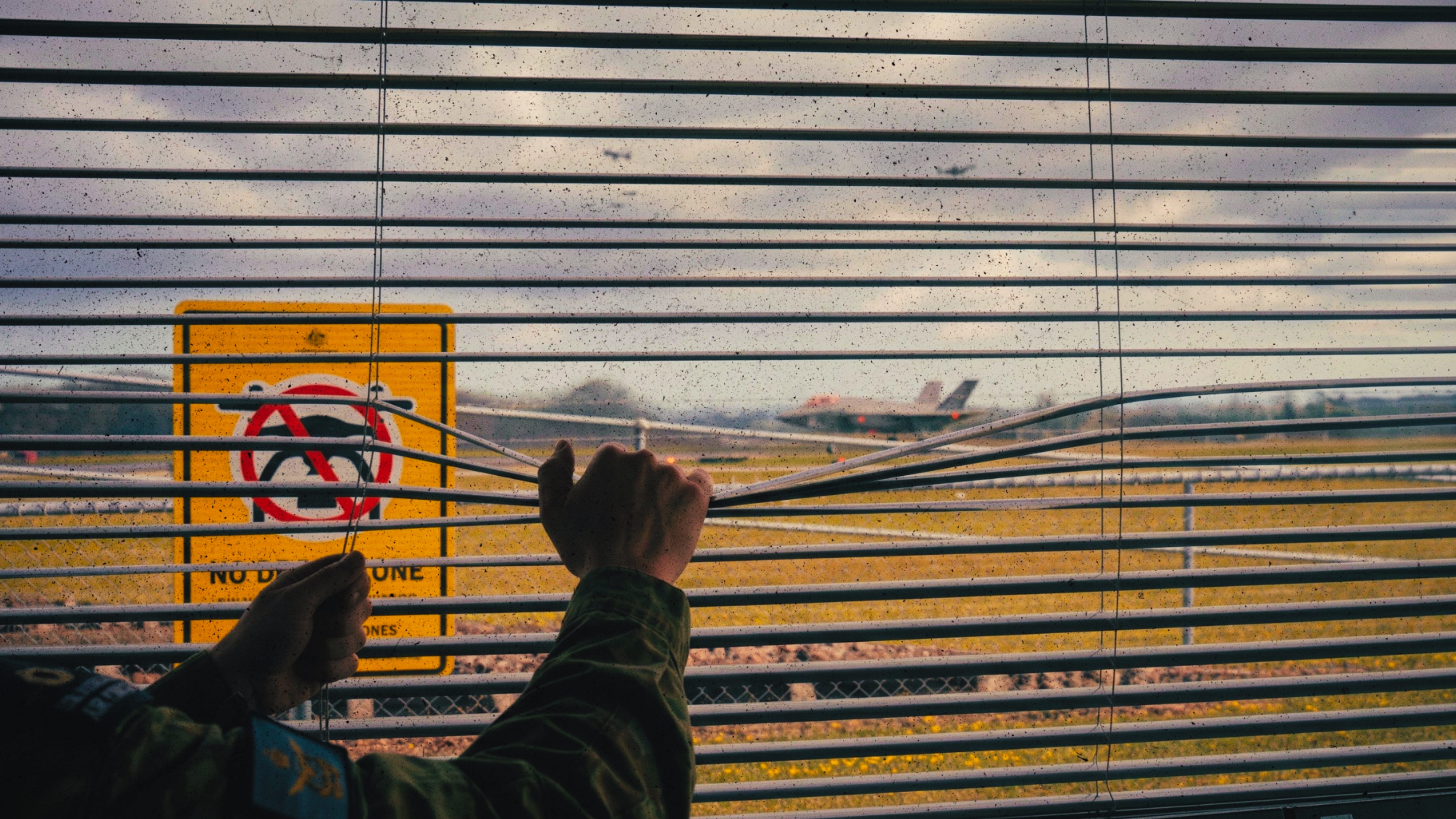
The response from base leadership when confronted by these unidentified aerial intruders? Base-wide alerts were sent out, warning systems were stood up, and commanders were told to advise personnel to “close the blinds” to prevent sensitive operational material from being visually intercepted.
The irony is as profound as it is alarming. When unknown objects penetrate our most sensitive sovereign airspace under the label of “drones,” Defence acknowledges a severe national security crisis, heavily redacts internal records, and points to multi-billion-dollar counter-measures. Yet, when unknown airborne targets demonstrate anomalous flight characteristics or refuse to fit neatly into the commercial quadcopter box, Defence buries its head in the sand.
The Williamtown incursions dismantle the myth that Australia has no need for a standardised, stigma-free reporting mechanism on unidentified anomalous phenomena. They serve as an urgent, undeniable wake-up call for the Australian Defence Force (ADF) to discard its outdated posture and implement sensible “see something, say something” reporting protocols for all anomalous aerial contacts.
Heavy Redactions, Warning Systems, and “Team Tiger”
My FOI request directly sought incident logs, internal briefing memos (specifically regarding the instruction to close window blinds), communications with NSW Police, and intelligence assessments concerning the 11–13 July incursions at RAAF Base Williamtown.
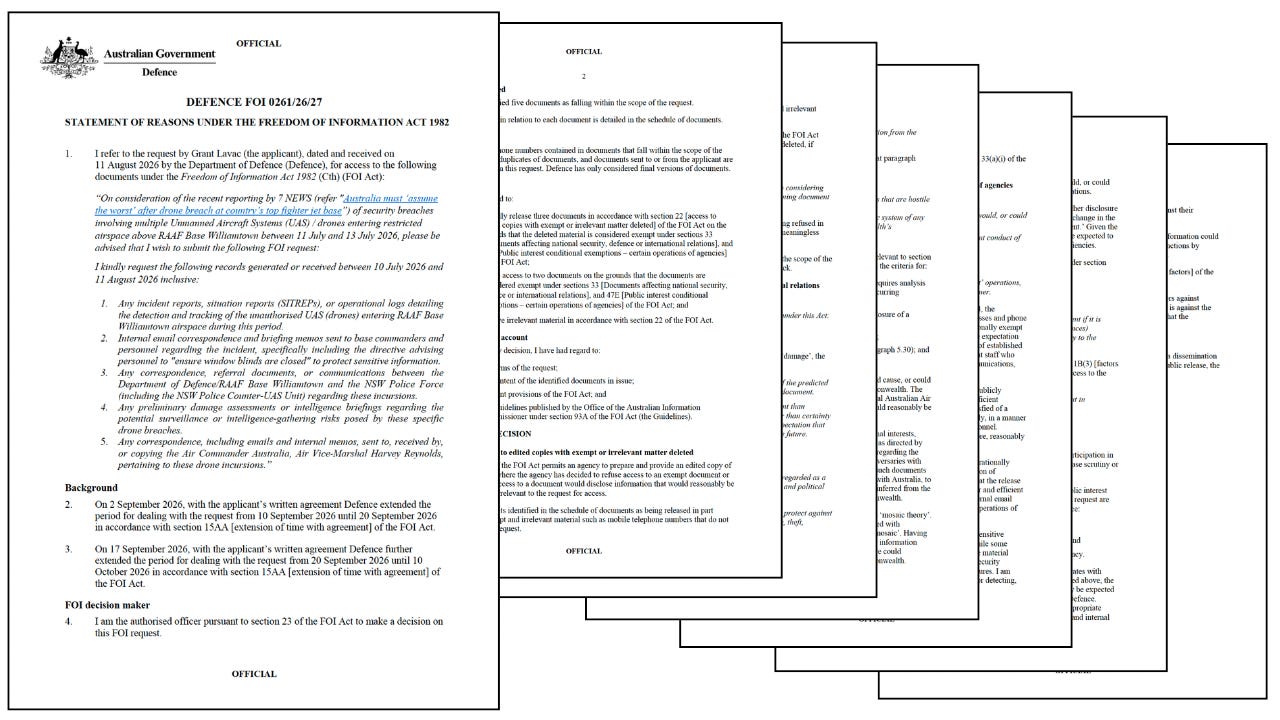
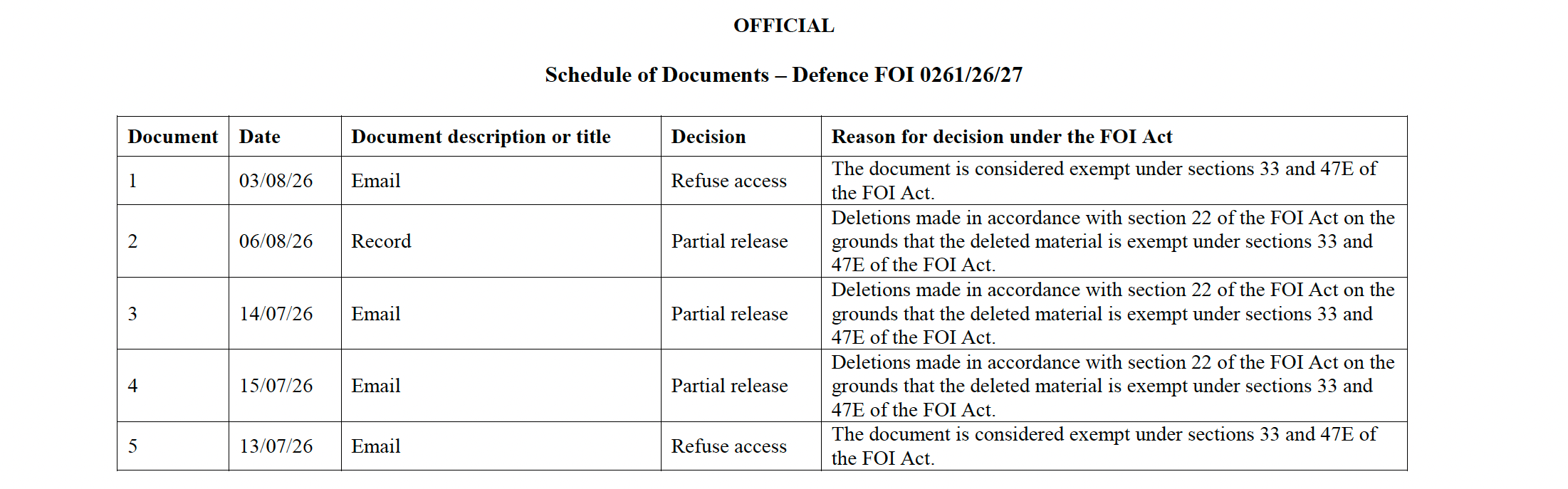
The decision - handed down by Air Commodore Sandy Turner - identified five responsive documents. Access to two documents was refused outright under national security exemptions (Section 33(a)(i)) and operational efficiency grounds (Section 47E(d)). The remaining three were released in heavily redacted form.
Despite the thick black redactions, what survives provides a stark operational snapshot:
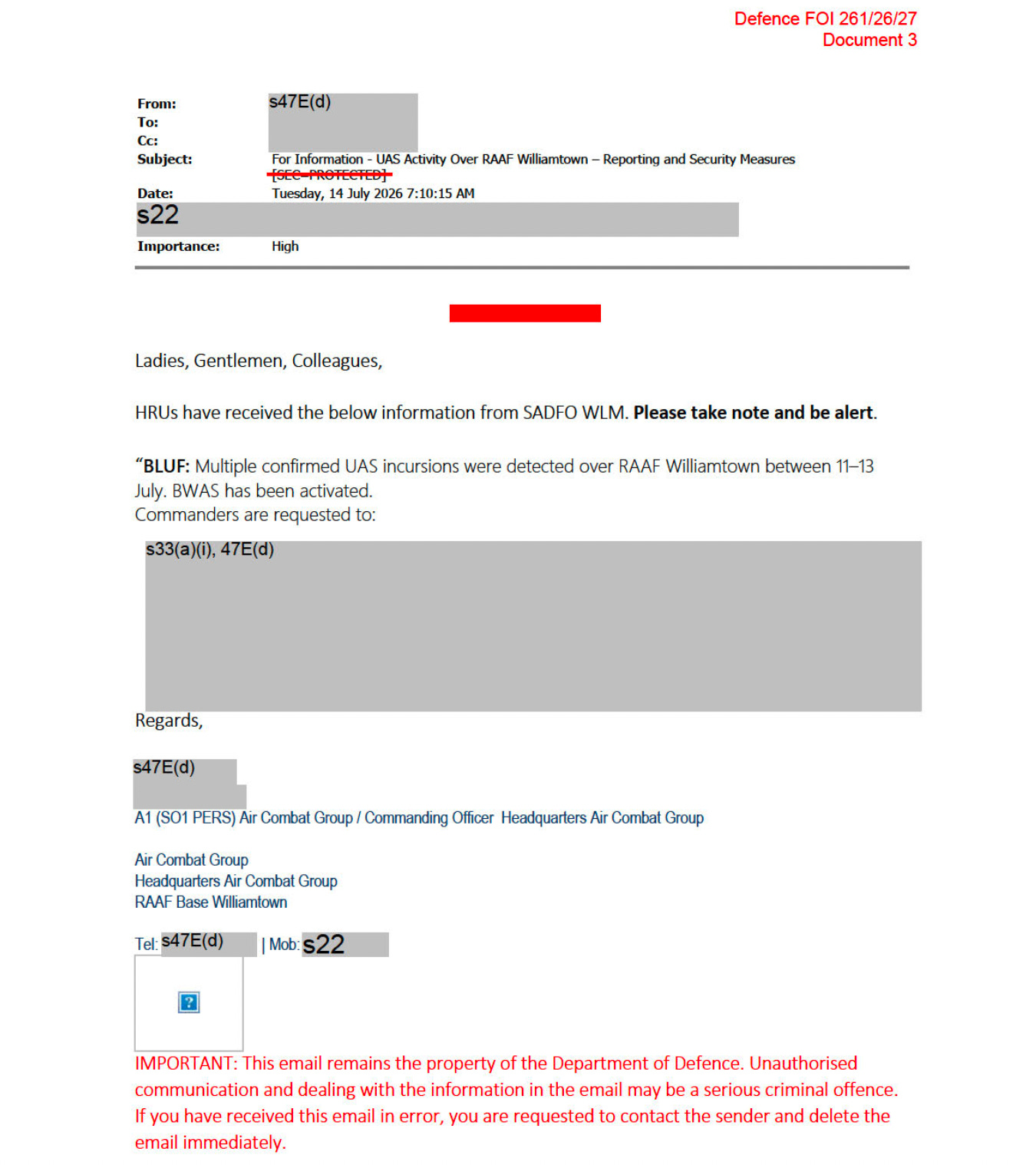
Document 3: Multiple Confirmed Incursions and BWAS Activation
An urgent email dispatched on Tuesday, 14 July 2026 at 7:10 AM by the Headquarters Air Combat Group (HQ ACG) to personnel, relaying an earlier notification from the Senior Australian Defence Force Officer (SADFO) at RAAF Base Williamtown, delivers the blunt operational reality:
“BLUF [Bottom Line Up Front]: Multiple confirmed UAS incursions were detected over RAAF Williamtown between 11-13 July. BWAS has been activated.”
While the operational acronym BWAS (Base Warning and Alert System) is explicitly referenced as having been activated, the immediate directives ordered by Base Command - specifically what commanders were instructed to do regarding base personnel, blinds, and intelligence exposure - are blacked out under Section 33(a)(i) and Section 47E(d).
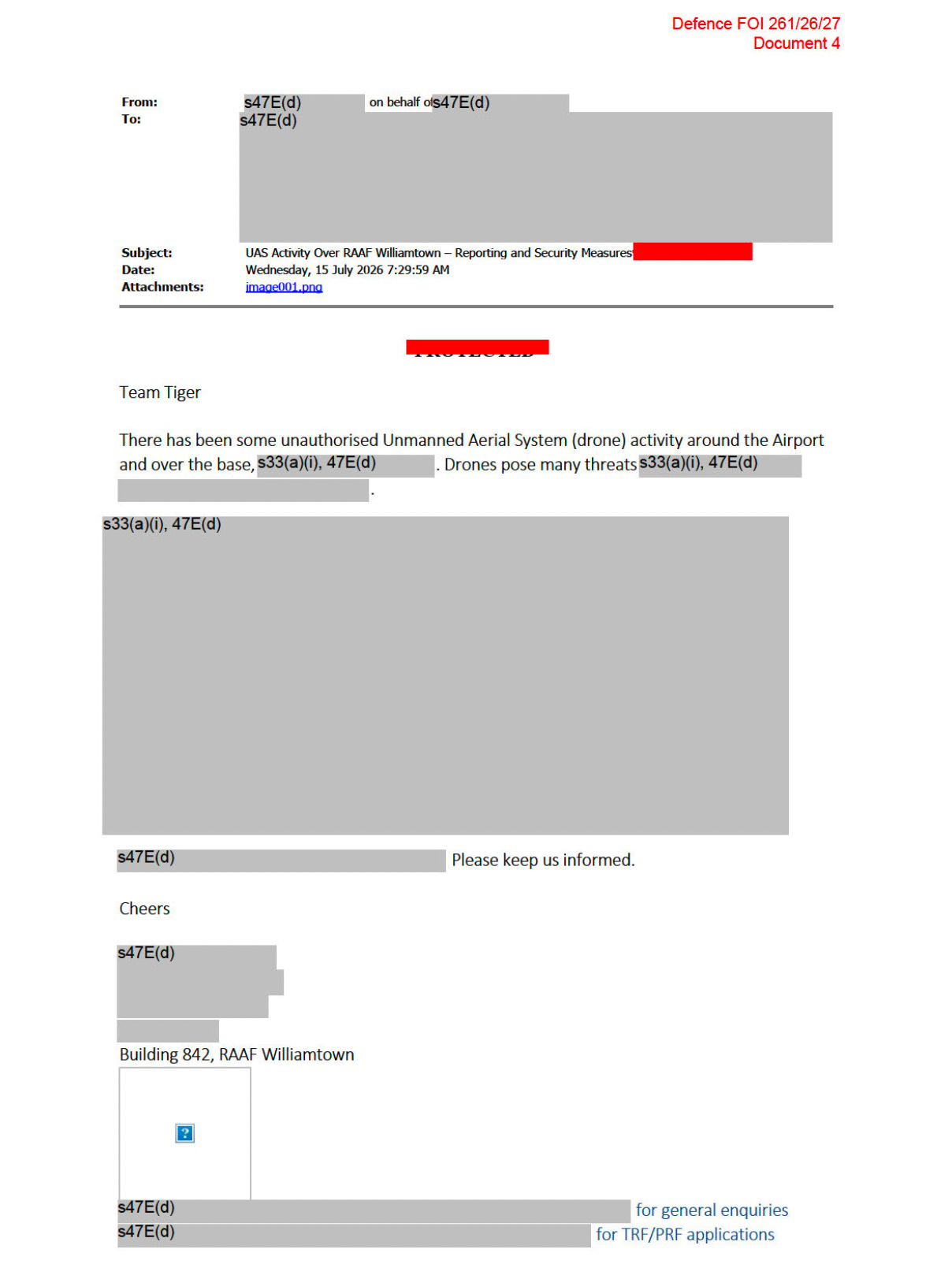
Document 4: “Team Tiger” and Airbase Vulnerabilities
On Wednesday, 15 July 2026, an internal communication sent to “Team Tiger” (No. 78 Wing / RAAF operational elements) warned:
“There has been some unauthorised Unmanned Aerial System (drone) activity around the Airport and over the base... Drones pose many threats...”
The rest of the operational threats and instructions remain masked behind national security redactions.
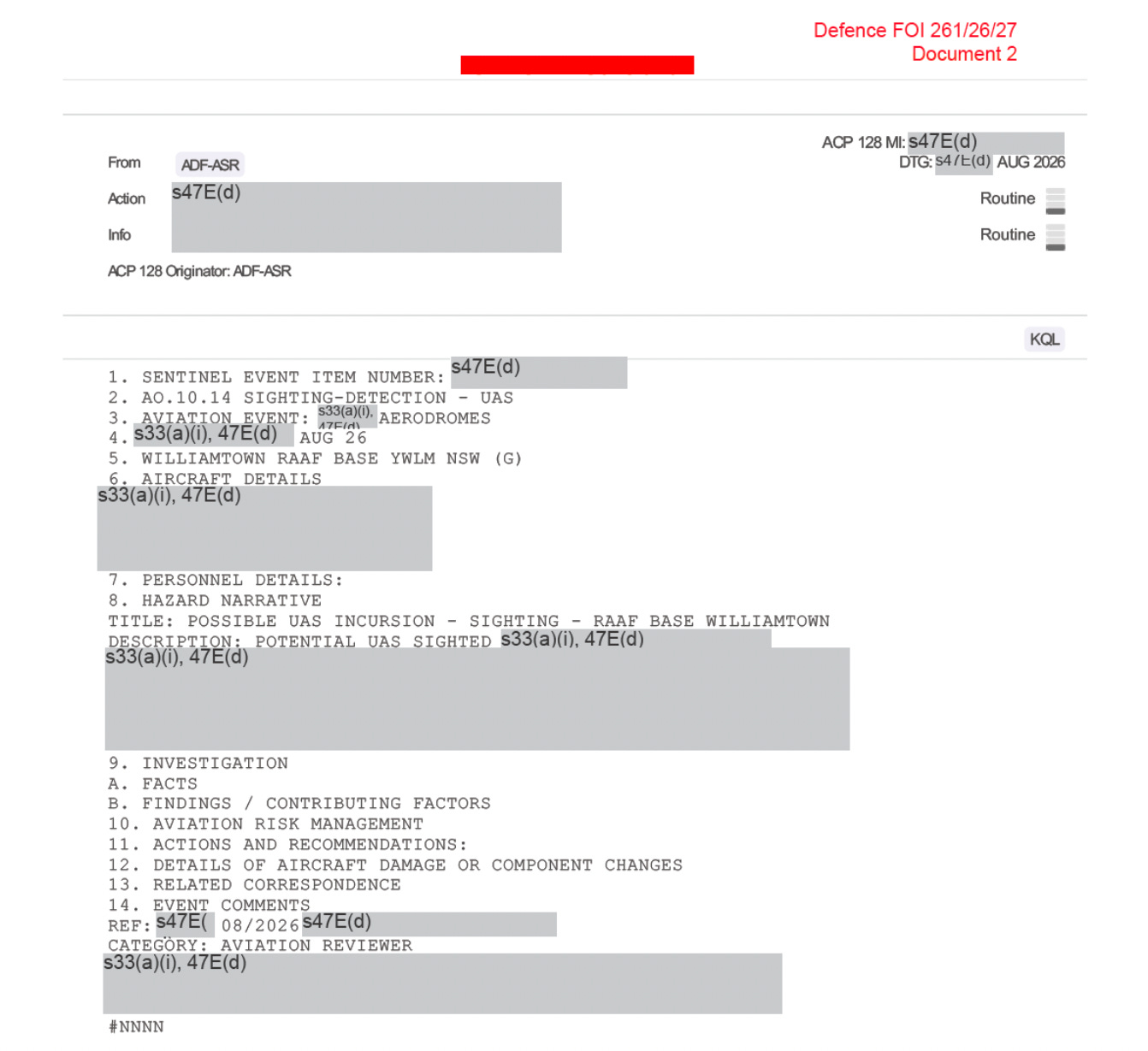
Document 2: The Aviation Hazard Report
A formal aviation safety record (ADF-ASR) dated August 2026 logs a “Sighting-Detection UAS” classified as a “Hazard Narrative” titled:
“POSSIBLE UAS INCURSION SIGHTING RAAF BASE WILLIAMTOWN”
“DESCRIPTION: POTENTIAL UAS SIGHTED...”
Nearly the entire investigative section - encompassing the facts, findings, contributing factors, aviation risk management, and event comments - has been excised under Section 33(a)(i).
The Justification: The “Mosaic Theory” and Vulnerability
In the formal Statement of Reasons, Air Commodore Turner defended withholding significant portions of the material by citing the “mosaic theory”:
“The exempt material contains sensitive information regarding the operations and capability of the RAAF and could potentially allow adversaries with hostile intentions to exploit Australian Defence Force capabilities. If such documents were disclosed, this could reasonably lead to Nation States not allied with Australia, to take steps or devote resources to counter and exploit any weaknesses inferred from the information contained...”
If revealing how Defence tracked or failed to track low-observable aerial objects over Williamtown provides a hostile nation state with exploitable intelligence, then Defence is tacitly admitting what the public has long suspected: Australia’s air domain awareness has critical, exploitable blind spots.
A Systemic Crisis: 147 Base Breaches in a Single Year
The Williamtown incursions were not a one-off stunt.
Subsequent figures revealed that unauthorised drone breaches across Australian military installations exploded from 21 in 2022/23, to 60 in 2023/24, and reached 147 incursions in the 2024/25 financial year.
Shadow Minister for Defence Industry and Personnel Phillip Thompson OAM revealed on national television that Williamtown personnel observed a swarm of up to 20 drones operating around the base’s northern gate. Thompson noted that frustrated Defence personnel contacted him directly, outraged that their operational directive was essentially to “close the blinds” while military bases were being “treated like a playground.”
Similar unauthorised incursions have been logged across Australia’s most critical defence installations:
RAAF Base Amberley (Super Hornets, Growlers, and visiting US strategic bombers)
RAAF Base Richmond (Tactical airlift and air mobility)
RAAF Base Edinburgh (Surveillance, maritime patrol, and intelligence gathering)
RAAF Base Townsville (Forward operational mounting base)
Interviewed on ABC Radio Newcastle, Minister for Defence Industry Pat Conroy pointed to a $7 billion, 10-year investment in counter-drone programs (Project LAND 156) and amendments under the Defence Amendment (Counter-UXS Measures) Regulations 2025 granting personnel authority to disable or destroy unauthorised drones. Yet, when pressed on whether any defensive action was taken at Williamtown, Conroy repeatedly stonewalled, citing operational security. He conceded, however, that the investigation was handed over to the NSW Police Force - an investigation that concluded without a single operator identified or apprehended.
How does an unknown operator fly multiple aerial craft over Australia’s premier fifth-generation combat aircraft base for three consecutive nights without a single platform being neutralised, seized, or identified?
Challenging the Secrecy
Accepting this blanket secrecy was never an option. On 15 October 2026, I lodged a formal Application for Internal Review with the Department of Defence, challenging the broad and disproportionate application of exemptions under Section 33(a)(i) and Section 47E(d).
The grounds for the review strike at the heart of Defence’s culture of reflexive non-disclosure:
Misapplication of the “Mosaic Theory” Against Public Facts: The primary facts surrounding the Williamtown breaches are already firmly in the public domain. Extensive reporting by major news outlets and national broadcasts has already established that unauthorised incursions occurred, the specific dates they took place, and that they triggered base-wide BWAS alarms. Refusing to release basic situational data - such as the exact number of objects, times of day, estimated dimensions/shapes, or duration in military airspace - does not protect national security; it merely obscures the scale of the incident from Australian taxpayers.
Conflating “Sensor Capability” with Raw Factual Observations: While specific technical parameters (such as classified radar frequencies, counter-UAS electronic warfare suites, or intelligence assessment methodologies) legitimately fall under national security protections, Defence has used Section 33(a)(i) to redact basic factual observation data. There is a sharp legal and operational distinction between disclosing how a target was tracked and disclosing the physical fact of what was observed (e.g., that an object loitered for 15 minutes or travelled along a specific heading).
Shielding Administrative Embarrassment Under Section 47E(d): Under Section 11B(4)(a) of the Freedom of Information Act 1982, decision-makers are explicitly prohibited from withholding information merely because disclosure could cause embarrassment to the Commonwealth Government. When unidentified craft penetrate restricted airspace over consecutive nights at our most vital fighter base, the public interest heavily favours transparency. Blanket non-disclosure strongly suggests an attempt to dodge scrutiny over base security shortcomings rather than a genuine operational necessity.
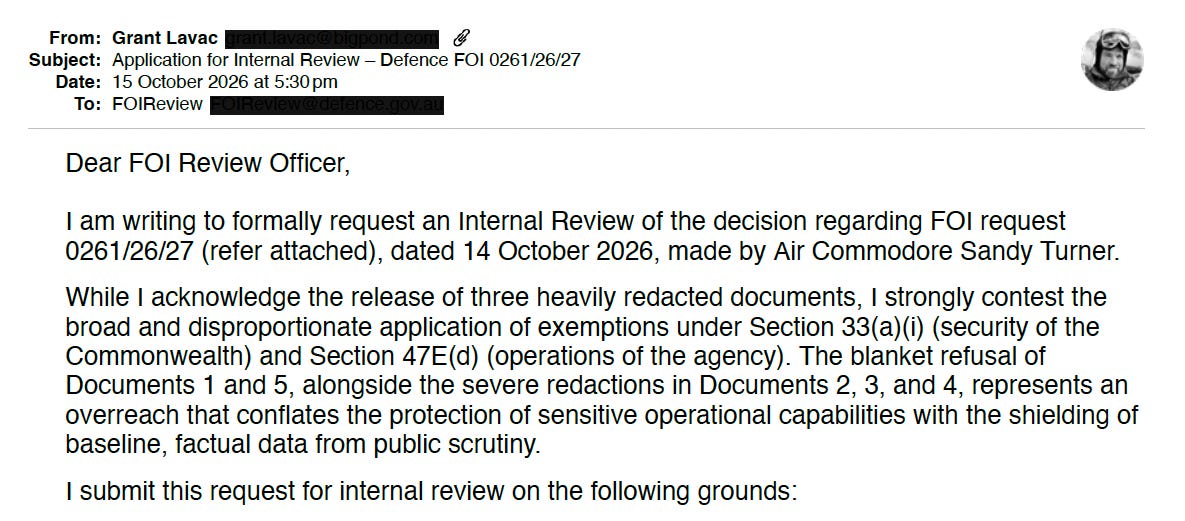
Extract from the formal Application for Internal Review lodged on 15 October 2026, challenging Defence’s broad application of the “mosaic theory” and distinguishing sensor capabilities from baseline factual observations. (Source: Lavac v. Department of Defence)
The review requests that a fresh decision-maker re-examine the unredacted files to release basic observational parameters and unclassified summaries of the events.
The UAP Blind Spot
This brings us directly to the wider contradiction in Australian defence policy.
In my recent Substack investigation, Did Australia Attend AARO’s Secret 2025 UAP Workshop?, I revealed declassified Pentagon records confirming that the “Australian Government” was an official participant in a closed-door, invite-only UAP workshop hosted by the Pentagon’s All-domain Anomaly Resolution Office (AARO) in August 2025.
While Australian officials quietly participate in Five Eyes summits addressing sensor integration, artificial intelligence, and anomaly resolution, the public-facing posture of the Department of Defence remains in total denial. For years, official inquiries regarding UAP have been brushed off with claims that Australia has no reporting mechanism, does not track such events, and views the matter as possessing zero defence relevance.
This posture of wilful ignorance is codified at the highest levels of the Australian military. Internal briefing notes prepared for the Chief of Air Force and Chief Defence Scientist for Senate Additional Estimates (released under Defence FOI 1011/23/24) lay bare Defence’s circular justification:
“Defence takes all threats to aviation safety or national security very seriously. Noting the multiple reporting mechanisms already in place, there would need to be UAP reporting of sufficient volume and credibility to justify consideration of allocating resources to establish a body similar to the AARO in the Australian context.”
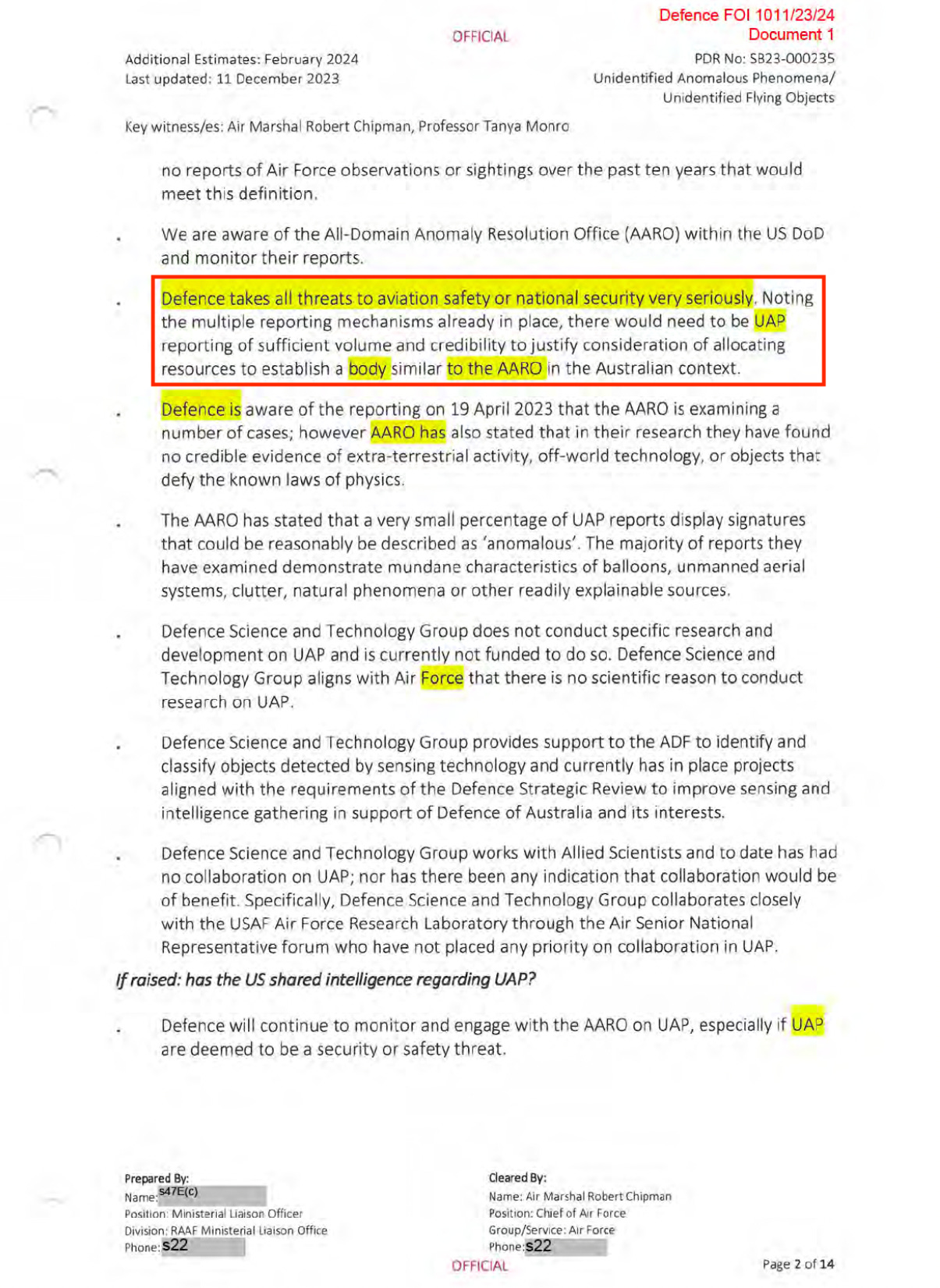
The logic is an institutional Catch-22: Defence claims it cannot establish a dedicated UAP office or reporting mechanism until it receives a “sufficient volume” of credible reports from Australian Defence Force personnel. Yet, as documented in my investigation Is Australia Being Honest About UAPs?, Defence ceased formal handling of UFO reports in 1996, maintains zero dedicated reporting channels, and leaves aviators and ground personnel stranded in a pervasive culture of career-ending ridicule. How can any service member submit a report of “sufficient credibility” when no formal reporting criteria exist, current safety systems discard anomalous data, and the cultural directive from leadership remains to mock the subject or look the other way?
Telling personnel to “close the blinds” during the Williamtown drone swarms is merely the physical manifestation of this deeper intellectual blind spot. The Pentagon only saw UAP reports surge into the hundreds - revealing serious foreign surveillance incursions and unresolved flight hazards - after it established formal, de-stigmatised reporting pipelines and legal whistleblower protections. By demanding proof of a problem while actively suppressing the means to measure it, Canberra ensures that vital intelligence slips through the cracks, disguised either as “unsubstantiated noise” or convenient commercial drone incursions.
The Williamtown drone incursions expose why this position is untenable:
Airspace Sovereignty Does Not Respect Labels: An unidentified airborne object operating in controlled military airspace presents the exact same safety-of-flight hazard and intelligence-collection risk whether an agency labels it a “drone,” a “UAS,” or a “UAP.” If the ADF cannot differentiate between an off-the-shelf consumer drone, an adversary’s advanced electronic-warfare platform, or an anomalous craft, our air defence net is fundamentally vulnerable.
The “Drone” Euphemism: Defence institutions often default to calling every unknown intrusion a “drone”—it sounds familiar, conventional, and low-tech. But when swarms loiter over high-security installations across multiple days and vanish without authorities ever locating the launch point, the recovery site, or the operator, they remain, by every objective measure, UNIDENTIFIED.
Institutional Stigma Stifles Defence Intelligence: Just as the United States military discovered prior to standing up formalised UAP reporting channels, ADF personnel who spot strange, high-performance, or hovering objects outside the base perimeter face systemic stigma. Telling personnel to “close the blinds” rather than recording structured sensor, optical, and eyewitness data actively suppresses crucial intelligence.
The Need for Sensible “See Something, Say Something” Reporting Protocols
In the United States, bipartisan congressional mandates forced the Department of Defense to enact formal, non-punitive reporting mechanisms for military pilots and personnel. AARO was created specifically to eliminate the stigma, standardise the data, and resolve domain anomalies.
Australia cannot afford to lag behind while our frontline installations are surveilled with impunity.
The Australian Department of Defence must take immediate action:
Institute a Formal “See Something, Say Something” Reporting Protocol: Establish a standardised, tri-service reporting pipeline across the RAAF, Royal Australian Navy, Australian Army, and civil air traffic networks (Airservices Australia). Any pilot, radar technician, or perimeter sentry who encounters an unidentified or anomalous object must have a clear, non-punitive channel to log the event immediately.
Integrate Cross-Domain Sensor Feeds: Ensure that Base Warning and Alert Systems (BWAS), civil radar, electro-optical sensors, and tactical airspace monitoring are synchronised to log RF signatures, flight telemetry, and kinematic behaviours whenever an unauthorised contact occurs.
Abandon the “Nothing to See Here” Charade: It is hypocritical to attend classified AARO data summits overseas while telling the domestic public that anomalous aerial phenomena do not warrant investigation. Parliament must demand transparency on the 147 military base incursions logged in the past year alone.
Pulling down the window blinds is not a national security strategy. It is an admission of failure.
If Australia is committed to defending critical sovereign capabilities like the F-35A and the E-7A Wedgetail, Defence must open the blinds, confront the reality of an increasingly contested airspace, and treat every unidentified aerial incursion with the transparency, data collection, and rigorous analysis it demands.
Download FOI documents
Defence FOI 261/26/27 - Statement of Reasons [7 pages, 241KB]
Defence FOI 0261/26/27 - Schedule of Documents [1 page, 106KB]
Defence FOI 0261/26/27 - Documents [5 pages, 1.4MB]
About Grant Lavac
Grant is a UAP activist, researcher and podcaster residing in Melbourne, Australia. Grant frequently leverages the Freedom of Information Act to better understand Australia’s involvement (or rather, lack thereof) on the UAP issue, and engages both his elected representatives and the legacy media in the hope they’ll take the topic seriously and treat it with the respect it deserves. Grant reports on his FOIA findings and engagement efforts via his podcast, The Unexplained Rundown, which is freely available on Spotify and YouTube. To follow Grant’s ongoing research, visit grantlavac.com.